Inside the appliance
Oven cooling fan. In plain English.
The cooling fan keeps the oven’s outer cabinet from overheating. The ES630 sheet reads its speed through a tachometer: F43 means too slow and F44 too fast. The 2017 modular sheet uses F45 for too low and F46 for too high.
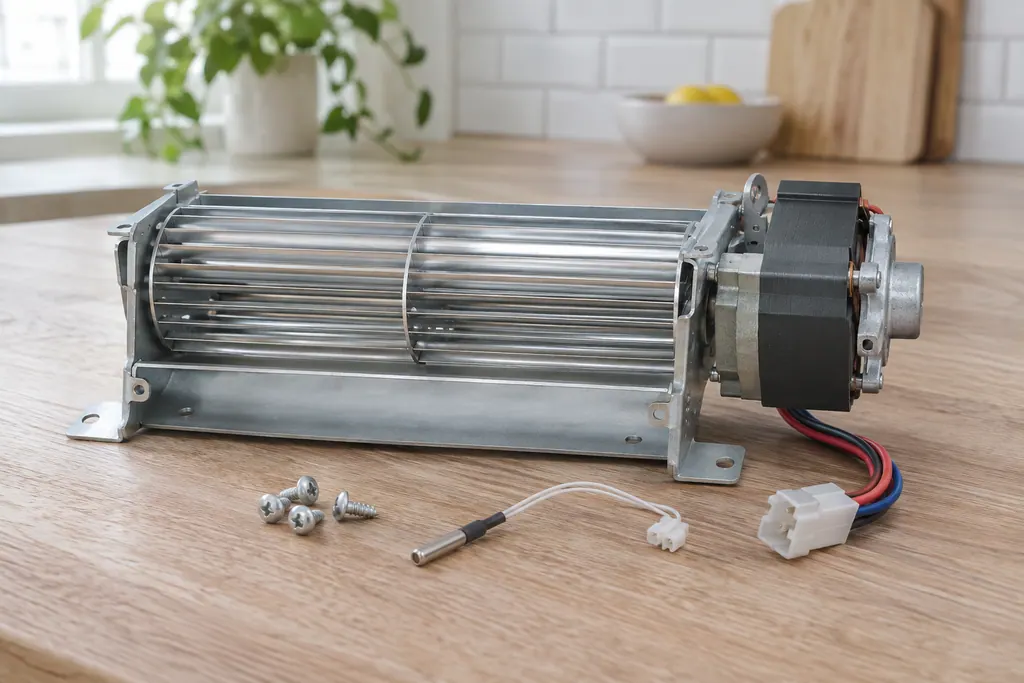
Where it fits.
Oven cooling fan in the appliance
The ES630 sheet points to the vent above the upper oven door, where you can feel airflow. It does not say where the fan sits.
The image shows the type of component only. It does not select a replacement that fits your model.
What is different once this system needs attention.
Oven cooling fan concerns may show up with a drop in performance or a code that keeps returning. Testing comes first before anyone decides the component has failed.
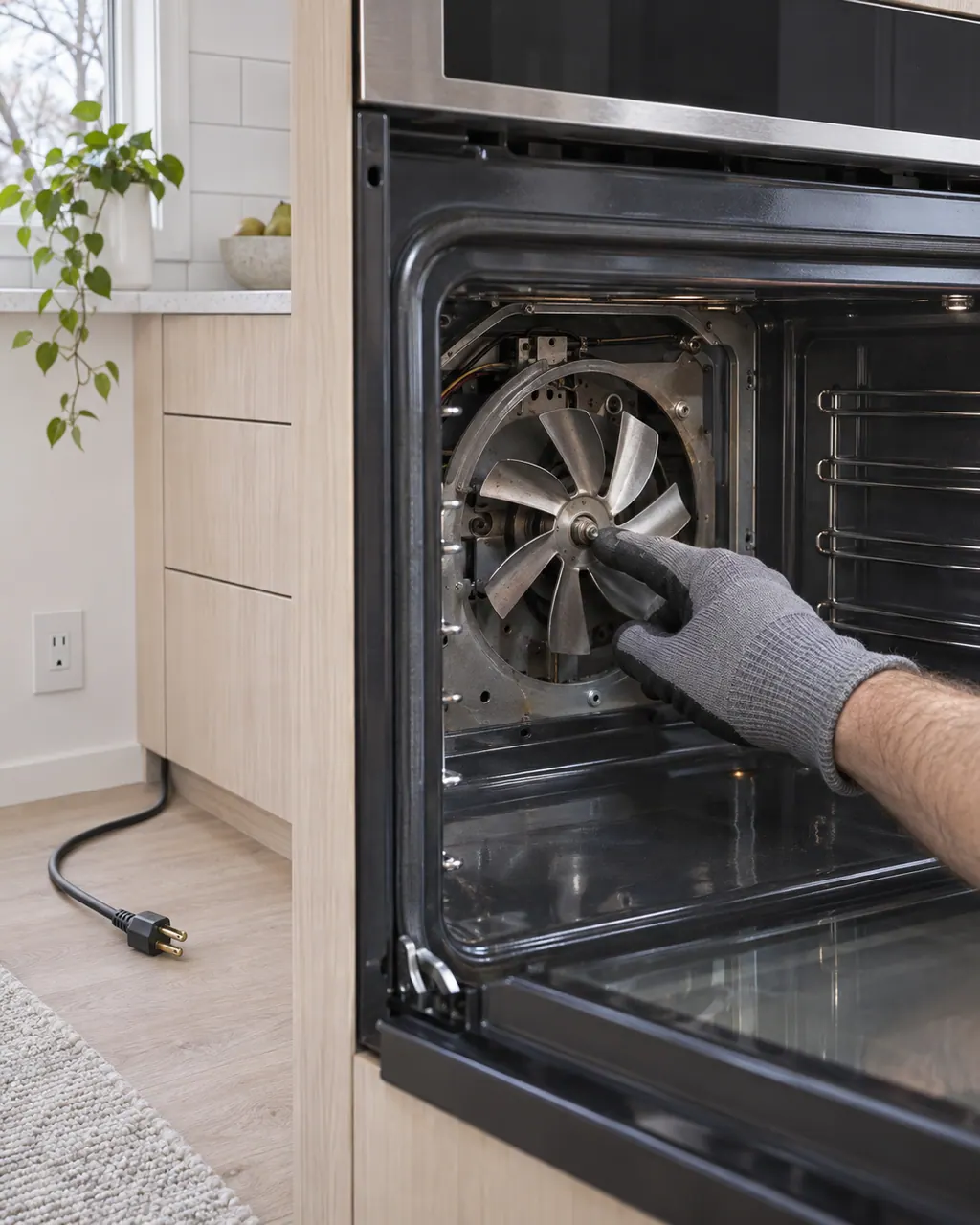
Owner care, within the model instructions.
Power the appliance down and pull the plug before any owner check. Beware of standing water and sharp debris. Never touch a wet plug or electrical area, take off service panels, or step beyond your model’s owner guide.
- 1
Feel for airflow
The ES630 sheet’s first test is to start a Bake and feel air coming through the vent above the upper oven door within 15 seconds. A fan can run for a time after cooking ends.
- 2
Expect it to run on
The ES630 sheet says the fan runs on low speed during any cooking function and stays on until the oven has cooled. High speed comes on for broil with the door open and during clean cycles.
- 3
Mind the airflow
Modular sheet F45 asks if the fan blades are blocked, and F46 asks about anything blocking the air path. At home, keep anything from covering the vent above the upper door, where the ES630 sheet has you feel for air.
- 4
Note your control
F43 and F44 appear only on ES630 ovens, and F45 and F46 only on modular ones. Mention the model number when you book.
Cleaning or replacement?
Leave internal testing to a technician.
Book a technician if F43, F44, F45 or F46 appears, or if the fan is noisy, silent or running at the wrong speed.
Arrange a diagnosticSee the neighboring components.
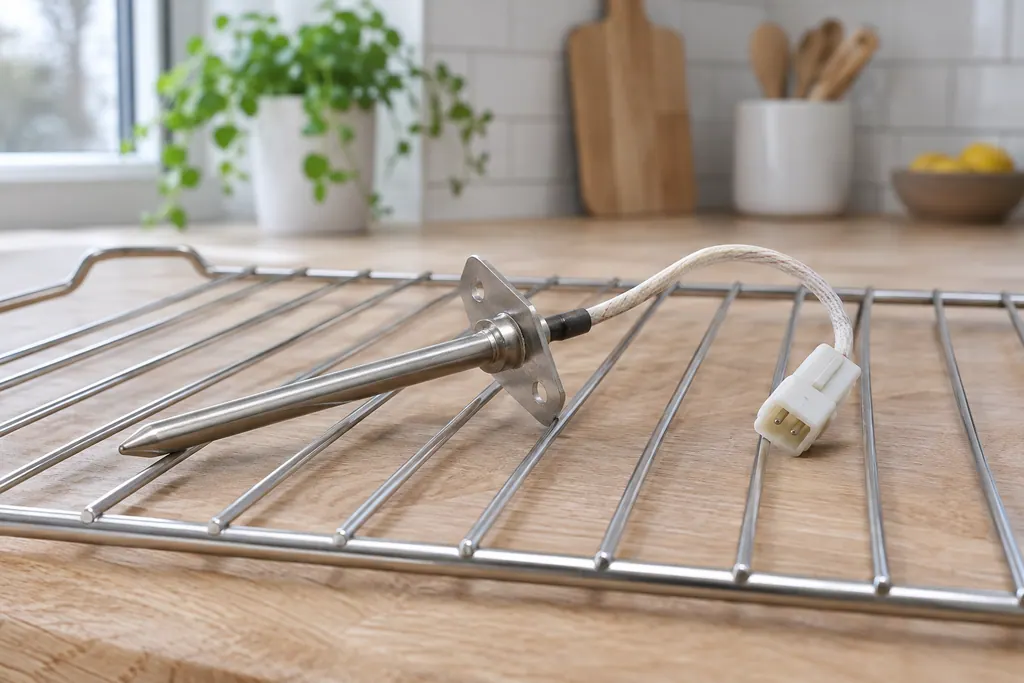
Oven RTD temperature sensor
The RTD is the oven’s temperature probe: a resistance temperature detector that tells the control how hot the cavity is. F30 means the probe circuit reads open and F31 that it reads shorted. On ES630 controls, F10 can also first appear when the probe misreads.
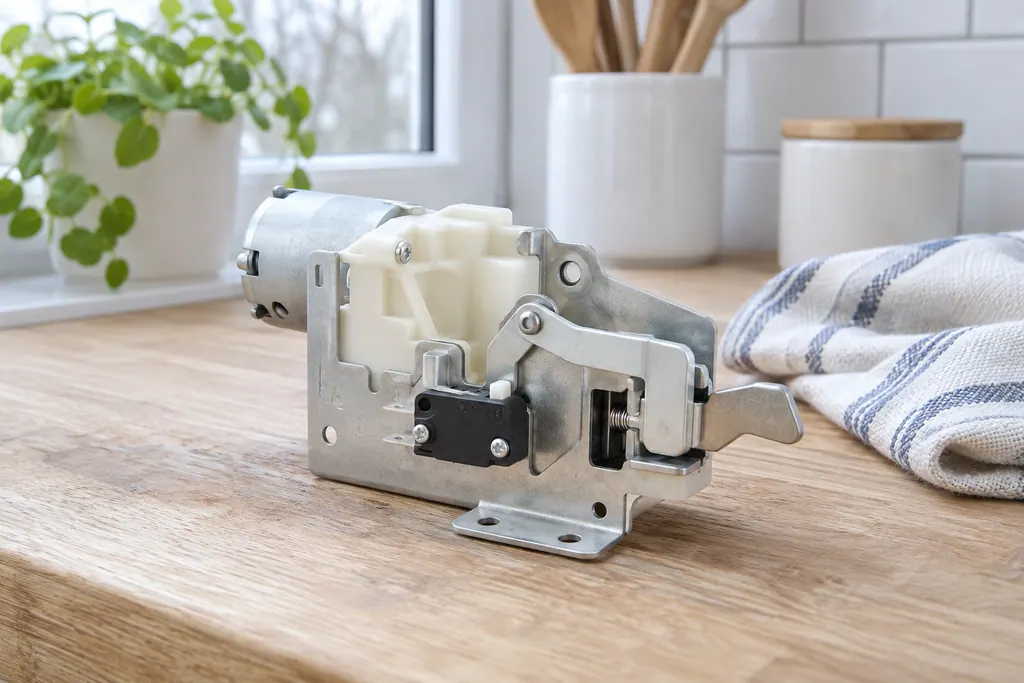
Oven door lock motor
The door lock motor turns the latch that holds the oven door shut during self-clean. Electrolux’s sheets use F90 for a failure of that mechanism, and the modular sheet adds F95 and F97. The owner guide groups F90 to F94 as a door lock issue.
Sources and model boundaries.
These sources back the Oven cooling fan guidance. Use the manual for your own model.
- Service Data Sheet, p/n 807436903, "Appliance with ES630 Electronic Oven Control" (EW30EW65PS)
- Service Data Sheet, p/n A00980644, "Electric wall ovens with modular oven controls" (EI30EW38TS)
Follow the guide for your exact model. Consult how we research these pages.
What do F43 and F44 mean?
Both are on ES630 controls. The display board reads fan speed from a tachometer input. F43 means it is abnormally slow, below about 700 RPM, and F44 abnormally fast, above about 2,500.
What are F45 and F46?
On the modular control, F45 is cooling fan speed too low and F46 too high. The steps are blocked blades or air path, the tachometer harness, then the fan, then the oven control.
Can the fan itself be fine?
Yes. If the fan seems to turn normally but F43 shows, the ES630 sheet blames the speed sensor reading, and its connection between the fan and the display board.
Why does the fan keep running after I turn the oven off?
The ES630 sheet says it stays on until the oven has cooled. That is expected, not a failure.
Codes, symptoms, parts and service
Link the message to what to do next.
F43
F43 applies to Electrolux's ES630 oven control only and means the cooling fan is turning too slowly. The display board reads the fan's speed and finds it abnormal. Modular ovens print F45 for the same condition. Book a technician.
Electrolux oven clock, timer or display problems
The written Electrolux articles say little about setting the clock or timer, since its display-settings guide is a video. What they do cover is a display or keypad that acts up: a stuck key (F11), memory and cable errors (F13, F14, F15), Demo mode and a power reset.
Oven repair
Book a diagnostic for your model at the appliance.
Find your metro
Office details and the access information to pass on.