On this page
- The ES630 cooling fan runs at low speed in any cooking function and carries on until the oven is cool. 1
- It runs at high speed in broil with the door open and in clean cycles above about 575 degrees F. 1
- Convection fans may run during preheat and during non-convection functions on the modular control. 2
- F43 and F44 are ES630 rows; F45 and F46 are modular rows. 12
- A quick vent check: feel for air above the upper door in the first 15 seconds of a Bake. 1
Which fan is which: convection or cooling?#
The convection fans circulate air as part of the cooking functions. The cooling fan is a separate two-speed fan that cools the oven, runs during any cooking and keeps going until the oven is cool. 12
Owners often hear one fan and blame it for the other. Knowing which is which turns a worrying noise into an ordinary one most of the time.
| Convection fans | Cooling fan | |
|---|---|---|
| Job | Part of the cooking functions (convection bake, roast, broil) 12 | Cools the oven during and after cooking 1 |
| When it runs | During those functions; may also run during preheat and intermittently in non-convection functions on the modular control 2 | Low speed in any cooking function and until the oven cools; high speed in broil with the door open and in clean cycles above about 575 degrees F (302 C) 1 |
| Speed control | Low and high speed on the sheets' fan lines 12 | The control sets the speed and reads it back 1 |
| Fan codes | None named on the sheets | F43 and F44 (ES630); F45 and F46 (modular) 12 |
Is it normal for the fan to keep running after the oven is off?#
Yes. The ES630 sheet says the cooling fan starts at low speed during any cooking function and does not switch off until the oven is cool. That is by design. 1
So a fan you hear once the oven is off, or after a long bake, is the cooling fan finishing its job. It speeds up for broiling with the door open and for self-clean above about 575 degrees F. 1 The oven will be louder in those two modes.
If the fan seems to run forever, give it time. A hot oven takes a while to cool, and the fan keeps running while it does.
Why does a fan run when I am not using convection?#
On the modular control, the sheet notes that the bake, broil and convection elements alternate their cycles, and that convection fans may run during preheat and may run intermittently during non-convection functions to improve cooking performance. 2
That means a fan sound during an ordinary bake is part of normal operation on that control. The modular sheet's circuit matrix even lists two convection fans, each with low and high speed, plus the cooling fan at low and high speed. 2 Our oven fan problems page continues from here if the noise has changed.
How can I check the cooling fan myself?#
Start a Bake and, in the first 15 seconds, feel for air coming through the vent above the upper oven door. The ES630 sheet uses that same check before it tests anything else. 1
- 1
- 2
- 3
- 4
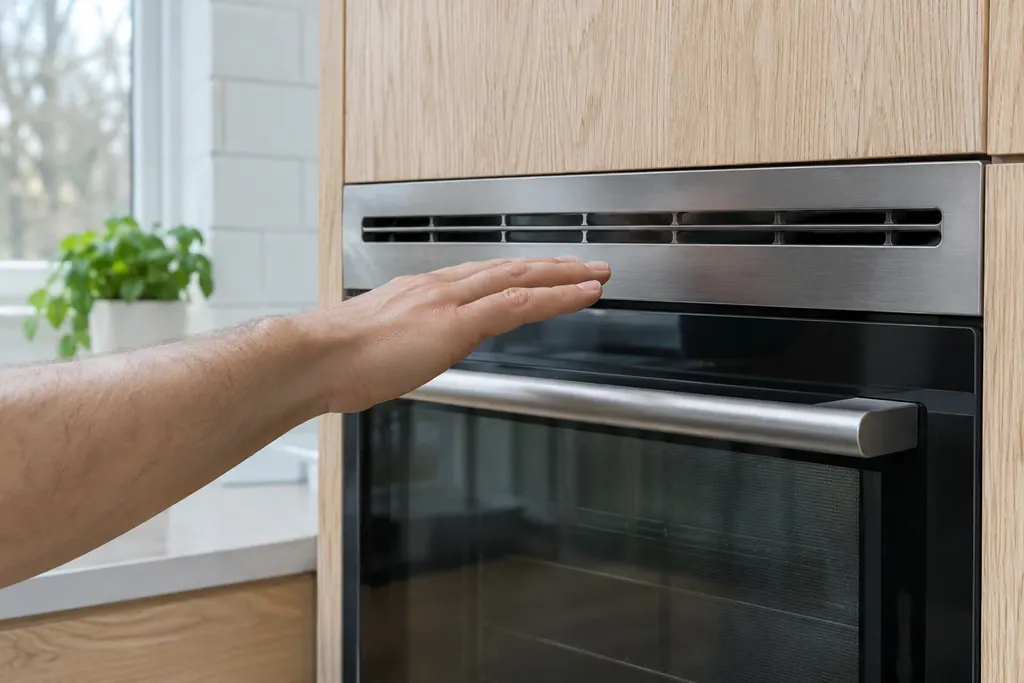
Feeling air tells you the fan turns, not that it turns at the right speed. A fan can turn and still be slow, which is why the control reads the speed back through a tachometer input and raises F43 or F44 when it is out of range. 1 So a quiet, steady breeze is a good sign, and an F43 with a breeze is a sensor question for the technician.
Does a double oven change any of this?#
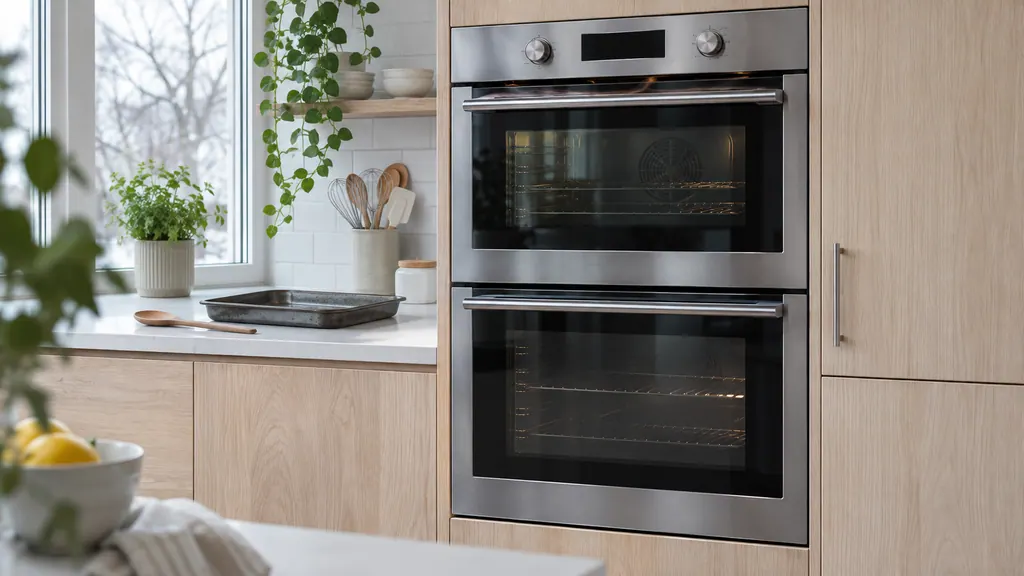
Only the bookkeeping. The ES630 sheet prints one circuit matrix for a single wall oven or the upper oven of a double, and a second for the lower oven of a double. The cooling fan is listed in both. 1 The fan check above is written for the upper oven.
The modular sheet likewise covers a single oven (EI30EW38TS) and a double (EI30EW48TS) in the same family of rows. 2 If you have a double oven, note which cavity you were using when the code appeared.
What do F43, F44, F45 and F46 mean?#
They are the oven reporting its own cooling fan. F43 and F45 mean too slow, F44 and F46 mean too fast. The ES630 uses F43 and F44, and the 2017 modular control uses F45 and F46. 12
- F43, ES630. The cooling fan speed, as read by the display board's tachometer input, is abnormally too slow. In normal use the sheet says the code is generated for a speed below approximately 700 RPM. 1
- F44, ES630. The speed is abnormally too fast, above approximately 2500 RPM. 1
- F45, modular. Cooling fan speed too low. The sheet's order is to check whether the blades are blocked, confirm the tachometer harness, then replace the fan and the oven control. 2
- F46, modular. Cooling fan speed too high. Check for a mechanical obstruction in the air path, then replace the fan and the oven control. 2
The full entries are on the F43 and F44 pages, with F45 and F46 as rows in the oven library. Which row applies depends on the control, so read the F14 and F15 guide if you are unsure.
What will a technician check?#
For F43, the first question is whether the fan is really slow or merely misread. The sheet tells the technician to check the voltage at the fan and, if power reaches it but it does not turn, to replace the fan motor. 1
If the fan turns normally but F43 still appears, the sheet blames the reading of the fan speed sensor and sends the technician to its connection. For F44 it adds that a voltage above 120 volts plus 10 percent could make the fan too fast, and that a blade must be well assembled. 1
The sheet also describes a test mode that displays the fan speed in RPM. A technician enters it by powering up the unit and, within 30 seconds, holding the upper oven Bake and Broil keys for 3 seconds. 1 It is not for owners.
The last step on F44 is to replace both the fan and sensor assembly and the display board if the problem persists. 1 Our cooling fan entry shows the part.
What about other oven sounds?#
Electrolux has an article titled How To Use Your Wall Oven: Common Sounds, but it is a video and carries no written text we can quote. 5 For a sound that is not one of the fans, your Use & Care guide is the place to look, and so is the model number on the nameplate if you call us.
Can airflow in the cavity affect my cooking?#
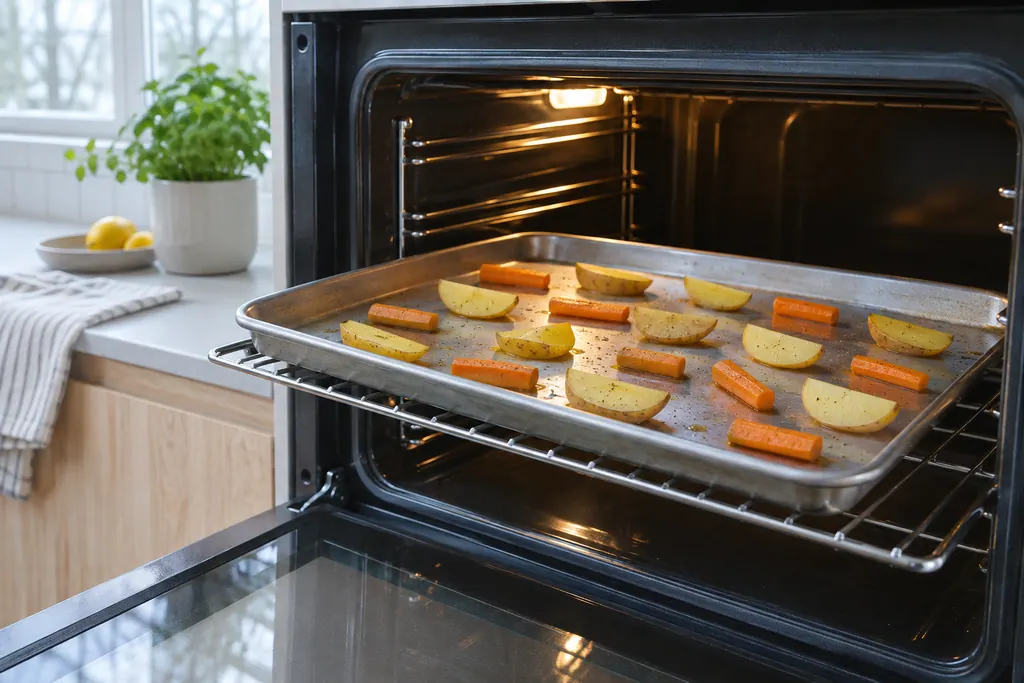
Yes, and this is the owner side of the topic. The Owner Center advises leaving air room around every piece of food and laying it out in one layer so it browns evenly. 4
For temperature, the Owner Center says to preheat fully, which can take up to 20 minutes, with the oven empty and the door closed, and to wait for the beep. 3 Those two habits cost nothing.
The same article lists rack placement and bakeware as influences on a hot or uneven result. Many recipes name a rack position, and the Use & Care guide has a bakeware guide that explains how material and shape change baking, even when the temperature and preheat are right. 3 If the oven still runs off after all that, the Owner Center says it may need a temperature calibration, with instructions that vary by model. 3
See the oven repair page for what a visit covers.
Sources#
- Service Data Sheet, p/n 807436903, "Appliance with ES630 Electronic Oven Control" (EW30EW65PS)Electrolux (technician sheet; retailer-hosted copy) · p/n 807436903 (Rev A 13/04); the same table appears in p/n 807436904 (EW30EW55PS) and p/n 807880710 / 807880711 (EW30DS80RS) · p. 1 (2-Speed Cooling Fan; F43 and F44)
- Service Data Sheet, p/n A00980644, "Electric wall ovens with modular oven controls" (EI30EW38TS)Electrolux (technician sheet; retailer-hosted copy) · p/n A00980644 Rev A (2017/05); p/n A00980645 (EI30EW48TS) is the double-oven version · pp. 1-2 (Circuit Analysis Matrix notes; F45 and F46)
- Oven - Is too Hot (KB 1846593)Electrolux / Owner Center knowledge base (owner.electrolux.com) · Knowledge-base page text saved 10.11.2026; no edition is printed on the page · article text
- Ovens - Why isn’t my food cooked evenly? (KB 1847391)Electrolux / Owner Center knowledge base (owner.electrolux.com) · Knowledge-base page text saved 10.11.2026; no edition is printed on the page · article text
- How To Use Your Wall Oven: Common Sounds (KB 1853580)Electrolux / Owner Center knowledge base (owner.electrolux.com) · Knowledge-base page text saved 10.11.2026; no edition is printed on the page · article is a video; no written steps on the page