Inside the appliance
Dryer control thermistor. In plain English.
Control thermistors are the temperature sensors that tell the dryer how hot the air is. Electrolux’s sheet names an outlet, an inlet and an exhaust thermistor. E71 to E74 mean an open or shorted sensor circuit, and EF1 and EF3 list them among the causes.
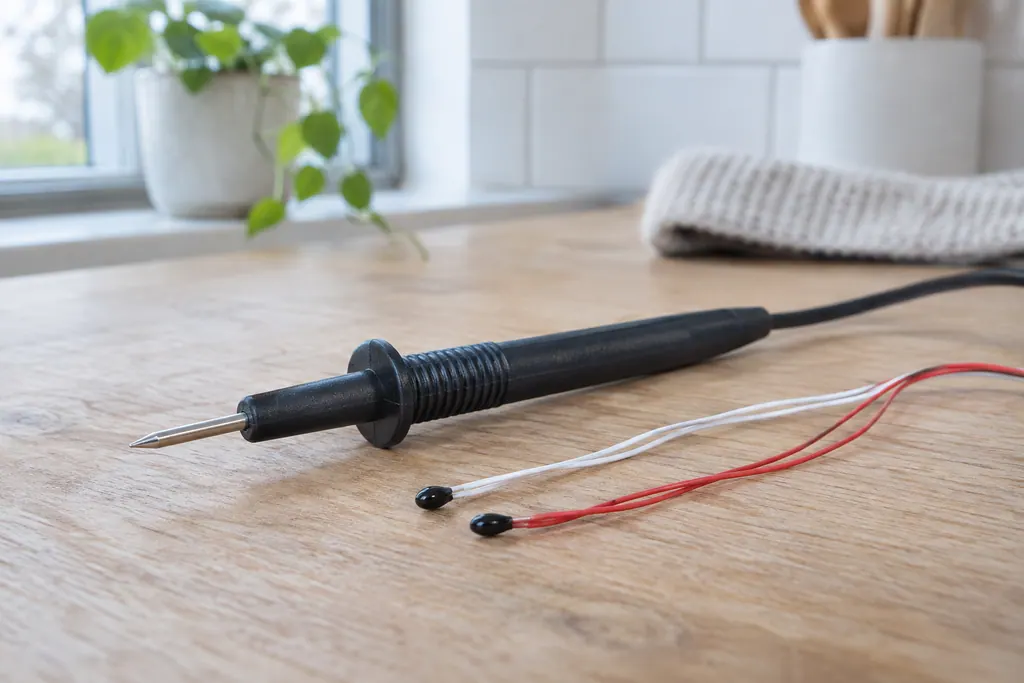
Where it fits.
Dryer control thermistor in the appliance
The sheet lists inlet, outlet and exhaust control thermistors, and its diagnostic mode labels them NTC1 and NTC2. It gives no positions in the text, so a technician locates them by model.
The image shows the type of component only. It does not select a replacement that fits your model.
What is different once this system needs attention.
Dryer control thermistor concerns may show up with a drop in performance or a code that keeps returning. Testing comes first before anyone decides the component has failed.

Owner care, within the model instructions.
Power the appliance down and pull the plug before any owner check. Beware of standing water and sharp debris. Never touch a wet plug or electrical area, take off service panels, or step beyond your model’s owner guide.
- 1
Check the vent path
For EF1 and EF3 the sheet lists a blocked vent first. Clean the lint screen, then look at the exhaust duct for bends and crushed sections, and at the outdoor hood for a clog.
- 2
Write down the exact code
E71 and E72 point at the outlet sensor; E73 and E74 at the inlet sensor. Open and shorted are separate rows, so the second digit matters to the technician.
- 3
Know the room-temperature values
The sheet expects 4.9K to 6.2K ohms for the outlet thermistor and 47K to 66K ohms for the inlet one at 68 to 77 degrees F. A technician measures that; an owner does not need to.
- 4
Skip the teardown
Electrolux’s sheet says its service steps are for qualified technicians only. The sheet’s fix for each row is to replace the thermistor and/or its wiring.
Cleaning or replacement?
Leave internal testing to a technician.
Book a technician for E71, E72, E73 or E74, or for EF1 or EF3 that returns once the vent is clear.
Arrange a diagnosticSee the neighboring components.
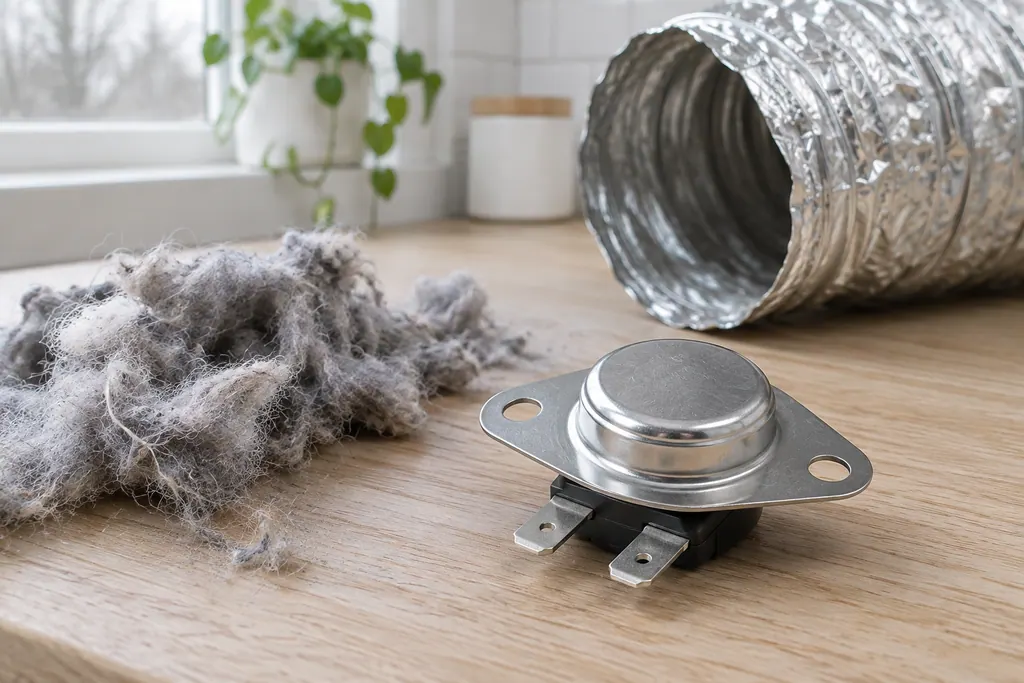
Dryer high-limit thermostat
The high-limit thermostat is a second temperature guard inside the dryer. Code E65 means the control has counted too many of its trips. Electrolux’s sheet blames a high vent restriction first, then the thermostat itself, then the inlet limiter on electric models.
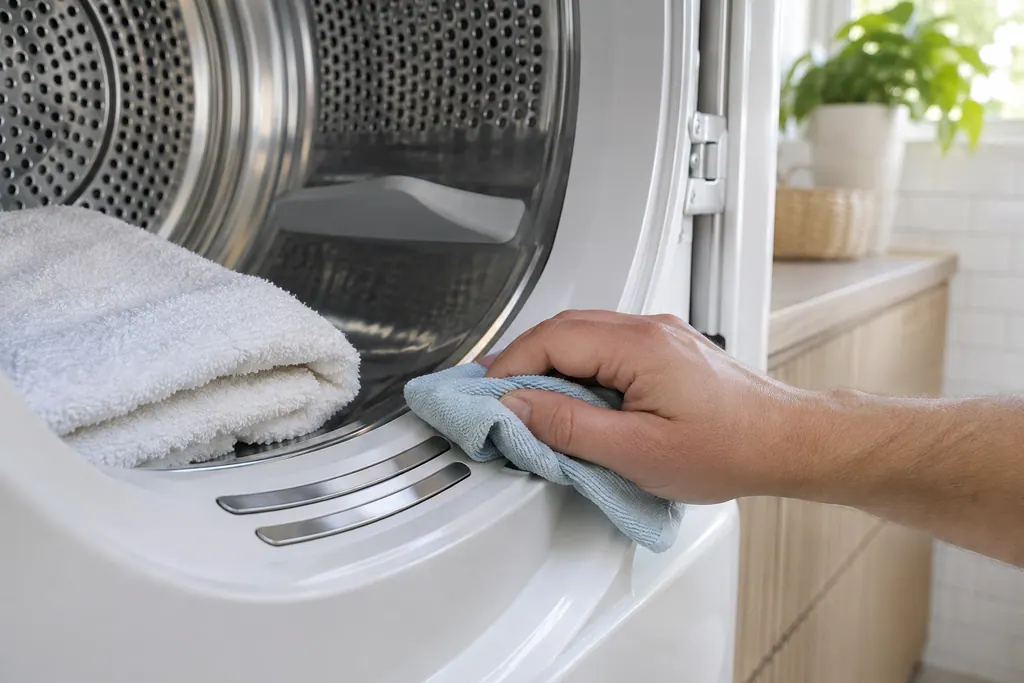
Dryer contact sensor
The contact sensor reads how damp the load is. Electrolux’s dryer sheet labels its test row “MOIST. BARS” and ties E31 and E32 to a frequency reading that is too high or too low. A foreign object touching the sensor is one listed cause.
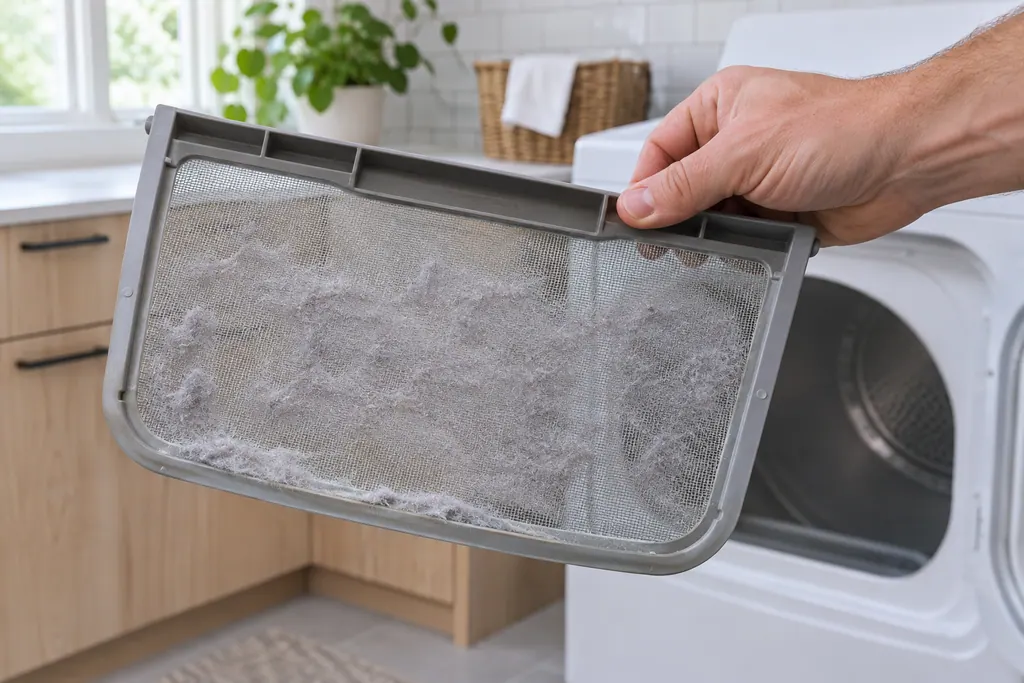
Dryer lint screen (lint filter)
The lint screen, also called the lint filter, catches lint from the air leaving an Electrolux dryer. Electrolux says to clean it before or after each load, because buildup blocks airflow and hurts drying. An EF1 code is the dryer's ventilation blockage message, and the lint filter is the first place its guide says to look.
Sources and model boundaries.
These sources back the Dryer control thermistor guidance. Use the manual for your own model.
- Dryer Tech Data Sheet, P/N 137265000B (1202)
Follow the guide for your exact model. Consult how we research these pages.
What is an open-circuit thermistor?
It means the sensor circuit reads as broken. The sheet prints E71 for the outlet and E73 for the inlet, and blames the thermistor or its wiring.
What does a short-circuit code mean?
E72 (outlet) and E74 (inlet) are the twin rows. The circuit reads as shorted instead of open, and the sheet gives the same two suspects: the thermistor and its wiring.
Why do EF1 and EF3 mention thermistors?
Both rows list the exhaust and inlet control thermistors beside a blocked vent. A blocked vent changes the temperatures the sensors report, and the sensors themselves can fail.
Can the dryer show me the temperature it senses?
Yes, in a technician’s diagnostic mode. The sheet’s test steps 5, 6 and 7 show the inlet and outlet values in degrees F on the display.
Codes, symptoms, parts and service
Link the message to what to do next.
E71
E71 means the outlet control thermistor is open circuit, per Electrolux's dryer chart. A technician checks its resistance, which should be 4.9K to 6.2K ohms at room temperature, and the wiring. Book a visit; the dryer may stop or misjudge heat.
Electrolux dryer noisy, rattling or shaking
Most dryer noise has a simple source: coins or buckles in the drum, a loose pedestal, shipping bolts still in place or a dryer that is out of level. Electrolux also lists sounds that are normal, such as the chime at the end of a cycle.
Dryer repair
Book a diagnostic for your model at the appliance.
Find your metro
Office details and the access information to pass on.